
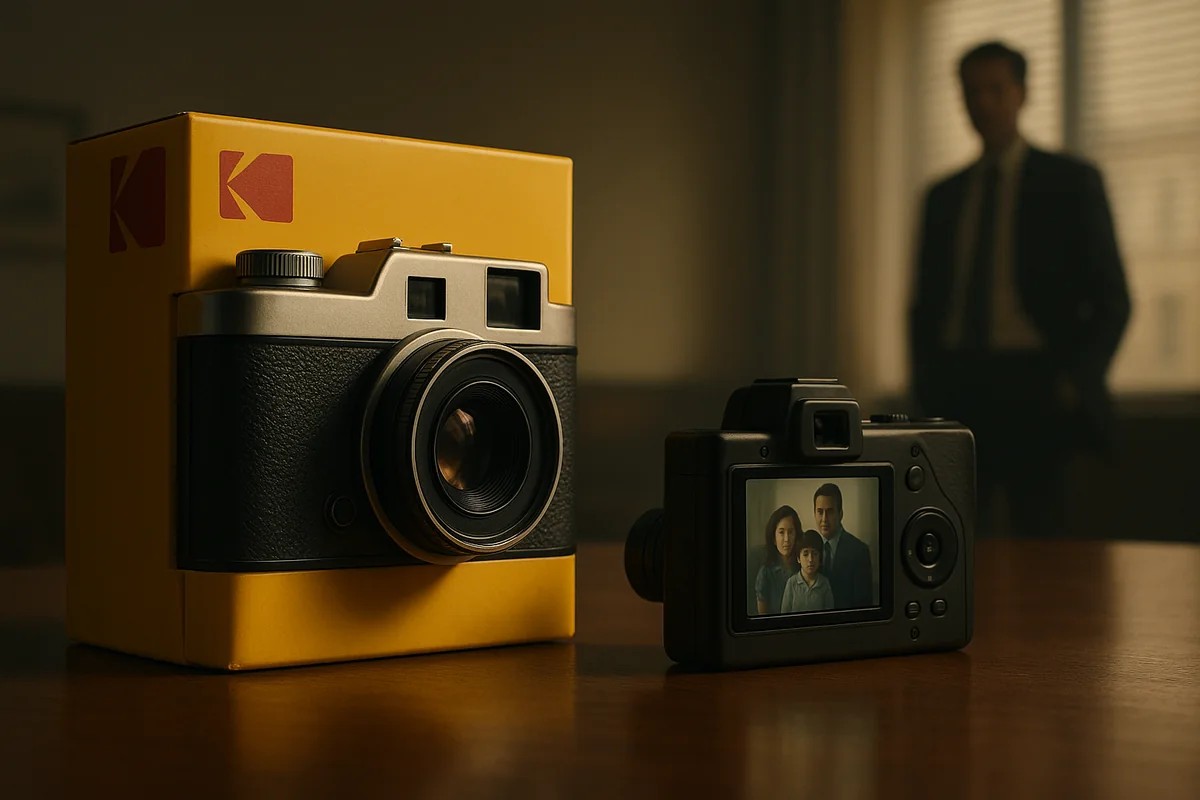
TL;DR: Kodak built the first digital camera in 1975, then shelved it to protect film profits.
By 2012 it was bankrupt, selling those digital patents for $525 million.
In 1976, Eastman Kodak controlled roughly 90 percent of American film sales and 85 percent of camera sales, a monopoly so complete that the “Kodak moment” became part of the language. Thirty-six years later, the same company filed for Chapter 11 with more than six billion dollars in debt. The uncomfortable detail at the center of that collapse: in December 1975, inside Kodak’s own laboratory in Rochester, New York, a 24-year-old engineer named Steven Sasson had already built the world’s first digital camera.
Watch the related video
An Eight-Pound Blue Box and a 23-Second Photograph
Sasson’s assignment was modest: figure out whether a new electronic component called a charge-coupled device (CCD) had any practical use in imaging. Working with parts scavenged from around the complex — a lens from a Super 8 movie-camera assembly line, sixteen nickel-cadmium batteries, an analog-to-digital converter adapted from a digital voltmeter, and dozens of hand-wired circuit boards — he assembled an eight-pound, toaster-sized blue box that captured images at a resolution of 0.01 megapixels: ten thousand black-and-white pixels.
To test it, Sasson photographed a lab technician. The machine hummed for 23 seconds while it converted light into digital ones and zeroes and wrote them onto a standard cassette tape. He then loaded the cassette into a custom playback unit wired to a television. After another 23 seconds, the screen flickered to life with a grainy silhouette of her face. The image was crude, but the proof was absolute: photographs could be captured, stored, and displayed with no film, no chemicals, and no paper.
“Why Would Anyone Want to Look at Photos on a TV?”
Sasson demonstrated the prototype to Kodak’s management, marketing executives, and business planners. The room did not applaud. The question he remembers hearing — why would anyone ever want to look at their pictures on a television set? — set the company’s course for the next three decades. Kodak allowed the work to be patented in 1978 as an “electronic still camera”, then kept the physical device out of sight and out of the product roadmap.
Sasson himself estimated that digital imaging would need fifteen to twenty years before its resolution and cost could compete with 35mm film. He turned out to be remarkably accurate — which meant Kodak had roughly two decades of warning, and spent them defending the status quo.
The 80-Percent Margin Kodak Refused to Cannibalize
The executives’ skepticism was not stupidity; it was arithmetic. Kodak was never really in the camera business. Cameras were sold near cost as an entry point, and the fortune was made on the recurring consumables: rolls of film, photographic paper, silver-halide chemistry, and processing services. Every shutter press anywhere on Earth paid Kodak a toll at each step of the developing pipeline, at gross margins on film approaching 80 percent. That cash funded the research labs, the executive payroll, and tens of thousands of manufacturing jobs in Rochester.
A filmless camera meant no film, no chemistry, no prints — no tolls. So the incentives inside the company hardened into a defensive crouch: bonuses and budgets were tied to quarterly film earnings, managers who hit film numbers were promoted, and champions of digital products looked like people volunteering to destroy their own divisions. Kodak’s researchers kept refining sensors and accumulating thousands of digital-imaging patents; its executives kept steering marketing money and shelf space toward film. It is the textbook case of what Clayton Christensen later named the innovator’s dilemma — the market leader paralyzed by the very profitability of the business being disrupted.
Tokyo Didn’t Have a Film Business to Protect
Sony, Canon, Nikon, and Fuji were not bound by silver and paper. Through the late 1990s they poured capital into consumer digital cameras, unburdened by legacy film factories, and iterated rapidly as sensor prices fell. When Kodak finally committed to the consumer digital market in the early 2000s with its EasyShare line, it briefly captured leading U.S. market share — and the victory was hollow. Digital cameras were commodity hardware with thin margins and relentless price wars. Kodak sold a camera once for a couple of hundred dollars, and the customer never bought film or processing again. The recurring revenue that had sustained the company for a century simply did not exist in the business it had been forced into.
Kodak announced wave after wave of restructuring — including plans in 2004 to cut up to 15,000 jobs as it shifted toward digital — yet the losses kept outrunning the cuts.
Then the market Kodak had spent billions entering was itself destroyed. Apple’s iPhone, launched in 2007, put a steadily improving digital sensor into a device people already carried everywhere. Point-and-shoot demand imploded as consumers stopped printing photos and started sharing them on screens.
The sharpest contrast is Fujifilm, Kodak’s mirror image in Japan. Facing the same collapse of the film market, Fujifilm aggressively redeployed its film chemistry into cosmetics, pharmaceuticals, and specialty materials — and survived as a diversified company. The difference was not foresight; both firms read the same data. The difference was the willingness to shrink a profitable film division before the market shrank it for them.
$525 Million for the Future Kodak Invented
By 2011 Kodak was borrowing at high interest just to cover payroll and legacy pension obligations, and shares that had traded above $80 at the 1997 peak fell below a dollar. On January 19, 2012, Eastman Kodak filed for Chapter 11 protection in the U.S. Bankruptcy Court for the Southern District of New York.
The proceedings dismantled the empire piece by piece. To satisfy creditors, Kodak sold its digital-imaging patent portfolio for approximately $525 million to a twelve-member consortium that included Apple, Google, and Samsung — the heirs of the technology Sasson and his colleagues had pioneered inside Kodak’s own walls. Rochester plants were closed, demolished, or sold, and a local workforce that once exceeded sixty thousand shrank to a small fraction of that. When the company emerged from Chapter 11 on September 3, 2013, it was a far smaller firm focused on commercial printing and packaging, its consumer imaging brand licensed away.
The Blueprint Was Never the Problem
Kodak’s collapse is often shorthand for “they missed digital.” The record shows the opposite. Kodak saw digital first, patented it first, and understood the timeline almost to the year. What failed was not invention but incentive design: a company structured so that everyone was paid to defend film could not bring itself to fund film’s replacement, even after its own engineer had built that replacement and its own analysts had dated the transition.
That is the transferable warning in this story, and it is sharper than “innovate or die.” Recognizing a disruptive breakthrough is worthless if your bonuses, budgets, factories, and supply chains are all structured to resist it. Protecting today’s revenue from your own invention does not preserve the revenue — it just reserves the destruction for a competitor. Kodak proves that inventing the future is the easy half; the hard half is being willing to abandon a wildly profitable past before the market abandons it for you.
Source note: This article is based on public records and linked reporting, including IEEE Spectrum’s account of the 1975 prototype, the original 1978 U.S. patent, and contemporaneous coverage of Kodak’s 2012 bankruptcy, 2012 patent sale, and 2013 emergence from Chapter 11.