
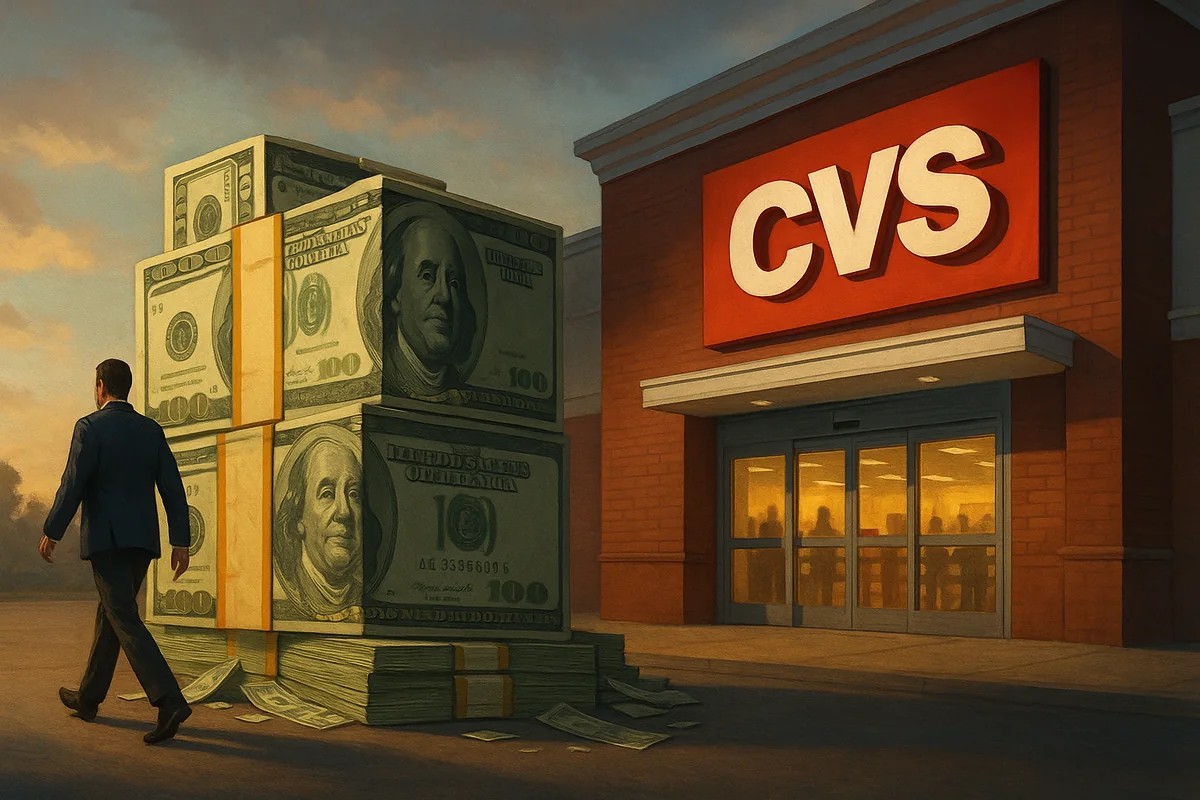
TL;DR: In 2014 CVS pulled tobacco from all 7,600 stores, forgoing about $2 billion a year.
The exit unlocked its healthcare pivot, capped by the $69 billion Aetna deal.
On February 5, 2014, CVS Caremark announced that every one of its more than 7,600 U.S. drugstores would stop selling cigarettes and other tobacco products by October 1 of that year. The company itself put the cost at roughly $2 billion in annual revenue, or about 17 cents per share. No national pharmacy chain had ever done it, none was being forced to, and the customers buying those cigarettes were walking past thousands of other products on their way to the register. Viewed as a retail decision, it was indefensible. Viewed as a strategic decision, it may have been the cheapest acquisition CVS ever made: the company was effectively buying permission to call itself a healthcare company.
A Drugstore Selling Nicotine Patches One Aisle Over From Cigarettes
By 2013, the front-of-store retail business that CVS was built on had become a commodity. Convenience stores, supermarkets, dollar stores, and Amazon all sold shampoo and snacks; margins were thin and foot traffic was flat. What CVS had that those competitors did not was a healthcare apparatus: a pharmacy counter in every store, a MinuteClinic business of roughly 900 walk-in clinics, and Caremark, a pharmacy benefit manager serving on the order of 65 million plan members. Growth, if it was coming from anywhere, was coming from there — from flu shots, chronic-disease management, and contracts with hospital systems and insurers that needed a low-cost front door to the medical system.
Tobacco poisoned that story. A pharmacist counseling a patient on blood-pressure medication worked yards away from a rack of Marlboros. CEO Larry Merlo put it plainly in the announcement: “Put simply, the sale of tobacco products is inconsistent with our purpose.” In the video message accompanying the news, he went further, saying the company had concluded that cigarettes have no place in a setting where health care is being delivered. The same day, CVS’s chief medical officer, Troyen Brennan, co-authored a viewpoint in JAMA with tobacco-control researcher Steven Schroeder framing pharmacy tobacco sales as a public-health problem — an unusual move that placed the business decision inside the medical literature from day one.
The Three Options on Merlo’s Desk
CVS had realistic alternatives, and each had a constituency inside the company.
It could have kept selling. Walgreens and Rite Aid did exactly that, and faced years of pressure from attorneys general and legislators without suffering any measurable commercial penalty. Tobacco margins were unremarkable, but smokers were reliable, frequent visitors who bought other items.
It could have phased tobacco out quietly — dropping it store by store, market by market, letting the revenue decline get lost in quarterly noise. This was the fiscally gentle path, and it is what a company treating tobacco as a pure P&L question would have done.
Or it could have restricted the category — moving cigarettes behind opaque panels, cutting promotions, adding cessation messaging — the harm-reduction theater that lets a retailer claim progress while keeping the cash.
The reason CVS took none of these paths is that none of them produced the thing CVS actually needed. Hospital systems weighing a clinical affiliation with MinuteClinic, and health plans weighing Caremark contracts, did not care whether tobacco was 2 percent of revenue or 1 percent. They cared whether CVS was a health company or a retailer wearing a lab coat. Only a loud, total, dated exit answered that question.
Two Billion Reasons to Do Nothing
The incentives against the move were concrete. The company guided to a 6-to-9-cent earnings hit for 2014 and 17 cents annually thereafter — real money for a management team compensated on earnings growth. Wall Street’s initial reaction was muted skepticism: the stock dipped modestly on announcement day, and analysts questioned whether goodwill could ever be booked against a $2 billion hole, since smokers would simply buy their cigarettes, and possibly their milk and toothpaste, at the Walgreens across the street. Helena Foulkes, the president of the CVS/pharmacy retail division, ran the business that had to absorb the entire loss, and she publicly championed the exit anyway — pairing it with a national smoking-cessation program launched that spring.
What Happened After September 3, 2014
CVS ended tobacco sales on September 3, 2014 — nearly a month ahead of its own deadline — and rebranded the corporation from CVS Caremark to CVS Health the same day. As NPR reported at the time, the stock was trading near a 52-week high and rose about 1 percent on the news, with the company positioning itself to capture newly insured patients under the Affordable Care Act. The feared exodus of smokers’ shopping baskets never became an existential problem: pharmacy and PBM growth carried the company, and front-store softness was manageable.
The public-health claim, unusually for a corporate gesture, was later tested by researchers. A study published in the American Journal of Public Health tracked household cigarette purchasing from 2012 through 2015 and found that smokers who had bought cigarettes exclusively at CVS were 38 percent more likely to stop buying cigarettes altogether after the ban, and that in states where CVS held at least 15 percent of the pharmacy market, average purchasing fell by roughly 0.14 packs per smoker per month. The effect was modest but real — the decision measurably reduced smoking rather than merely relocating it.
The strategic payoff compounded over the following years:
- CVS became, and remains, the only national drugstore chain that sells no tobacco, converting a one-time write-off into a permanent differentiator.
- Health-system partnerships and clinical affiliations expanded around MinuteClinic, which no longer had to explain the cigarette rack to hospital boards.
- In December 2017, CVS Health agreed to buy the insurer Aetna, and the roughly $69 billion merger closed in November 2018, fusing pharmacy, PBM, clinics, and insurance into one vertically integrated healthcare company.
It is worth being precise about causality. The tobacco exit did not make the Aetna deal happen, and it did not immunize CVS against later troubles — PBM scrutiny, store closures, and a 2024 CEO change all followed. What it did was make the healthcare identity credible at the moment credibility was the binding constraint. It is hard to imagine regulators, Aetna’s board, and the medical establishment engaging with a tobacco retailer’s bid to run an insurer quite the same way.
The Tell an Outsider Could Have Spotted
None of this required inside information. In early 2014 an outside observer could see three public facts: retail pharmacy margins were commoditizing; CVS’s earnings growth was increasingly driven by Caremark and clinical services rather than the front store; and every health-system partnership announcement invited the same awkward question about cigarettes. Given those facts, $2 billion in tobacco revenue was not an asset — it was a lien against the company’s next decade. The tell was that CVS announced the exit with a hard date, a JAMA article, and a CEO video, rather than burying it. Companies quietly shed businesses they consider losses; they publicize exits they consider investments.
When Losing Revenue Buys Strategic Permission
The CVS case supports one narrow, specific conclusion: when a company’s declared future depends on being trusted by a different set of counterparties than its past, a visible, verifiable sacrifice can function as the entry fee. The $2 billion was not destroyed value; it was the price of a signal that could not be faked, because a faker would not pay it. A quiet phase-out would have cost CVS nearly the same revenue while purchasing none of the credibility. What made the decision rational was not that the loss was small — it was that CVS had identified exactly who needed convincing, and what it would take. The lesson travels only that far: forgone revenue is an investment precisely when someone the strategy depends on is watching, and only skepticism that expensive can be overcome.
Source note: Figures and quotations are drawn from CVS corporate announcements, contemporaneous reporting by NPR and CNBC, and peer-reviewed research in JAMA and the American Journal of Public Health, linked above.