
TL;DR: Michael Carroll won £9.7 million at 19 and was broke within about a decade.
He now hauls coal in Scotland and says he is happier without the money.
The man loading coal sacks onto a delivery truck in Moray, in the northeast of Scotland, once held one of the most photographed checks in British lottery history. In 2019, Michael Carroll was reported to be working as a coalman for about £10 an hour, seven days a week — a physical, repetitive job he described without a trace of complaint. “I live a good, free lifestyle now and I’m happier because I’ve got my life back,” he said. Asked to sum up the £9.7 million he had run through, his accounting was blunt: “It was 10 years of fun for a pound, you can’t go wrong with that.”
That is the ending. The beginning explains why the tabloids spent a decade calling him the “Lotto Lout” — and why this case remains the standard British example of what happens when a life-changing windfall lands on a teenager with no structure around it.
Watch the related video
November 2002: A £9.7 Million Ticket and an Electronic Tag
Carroll was 19 and working as a trash collector in Norfolk, England, when he won £9.7 million on the UK National Lottery in November 2002. The detail that defined his public image from day one: he was wearing an electronic offender tag for being drunk and disorderly when the win came through. The money did not arrive into a settled life it then disrupted; it arrived into a life already tangled with the courts, and it scaled everything up.
He bought The Grange, a mansion in Swaffham, Norfolk, and moved in with his girlfriend and baby daughter — along with a rotating cast of friends. In his own autobiography, quoted by The Guardian, he described the household plainly: “Almost every night and most afternoons we had the wildest parties… women, drink and drugs,” including, on at least some occasions, “sword fights with real swords.”
Banger Races on the Lawn: What Happened to The Grange
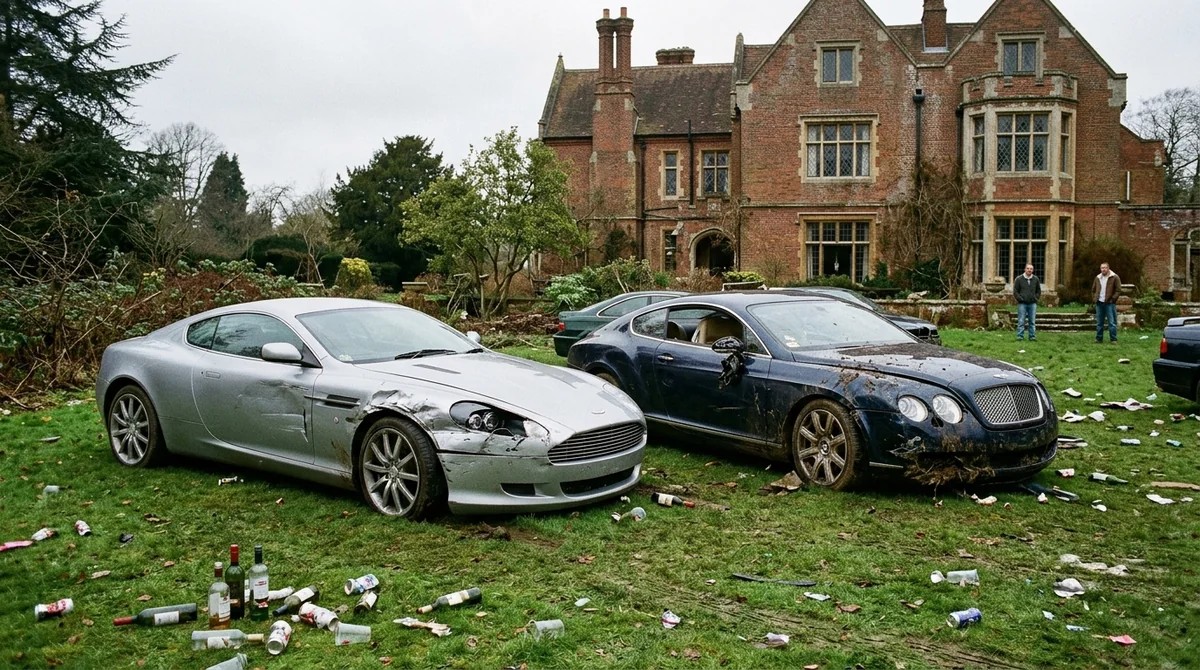
The mansion became the most visible symbol of how the money left. Rather than maintaining the property, Carroll turned its grounds into a crash site: local reporting described him hosting banger races in the garden of The Grange, wrecking cars for entertainment beside the A47 and infuriating his neighbors. The same reporting described him spending thousands of pounds a day on crack cocaine at the height of it, with drug-fueled parties as the default state of the house. His marriage collapsed within months of the win.
Not all of the outflow was chaos. By his own later account, roughly £4 million — nearly half the prize — reportedly went to family members as gifts. The rest went into property, cars, jewelry, trips, drugs, and the daily cost of being the most famous spendthrift in Britain. There was no trust, no staged payout, no adviser with authority to say no. The prize was paid as a lump sum to a teenager, and it behaved accordingly.
An ASBO, 30-Plus Court Dates, and Nine Months for Affray
The legal record ran alongside the spending. In 2005, The Guardian noted that Carroll had made more than 30 court appearances since the win and had received an anti-social behaviour order (ASBO) from King’s Lynn magistrates after firing ball bearings from a catapult at shop and car windows — 32 windows destroyed, thousands of pounds in damage, and 240 hours of community service. By then he was such a fixture of British tabloid culture that Channel 4 commissioned a documentary about him.
Prison followed. In 2004 he served five months for failing to comply with a drug treatment order after a cocaine offense. In 2006 he was jailed for nine months at Norwich Crown Court for affray, after he and three friends — carrying baseball bats — waded into a fight at a Christian rock concert in Downham Market. At sentencing, his own attorney relayed the family’s verdict: Carroll’s aunt considered the lottery win “the worst thing that ever happened to him.”
£42 a Week by 2010: Selling the Mansion He Couldn’t Keep
By around 2010, at age 26, the fortune was effectively gone. Carroll was reported to be back on jobseeker’s allowance of £42 a week — the UK’s unemployment benefit — while his agent confirmed the money had run out and The Grange was going on the market. Reports in the years that followed said he had lost the money and three properties by about 2012. He publicly said he wanted his old trash-collection job back. The arc that took eight years to build — teenager, jackpot, mansion, tabloid infamy — unwound into a benefits check in less than that.
Elgin, Shortbread, and £204 a Week: The Recovery Years
Recovery, when it came, looked like distance and routine. Carroll moved to Scotland, and by 2013 he was packing shortbread on a factory assembly line in Elgin, in Moray, earning about £204 a week. His statements from that period are the closest thing on record to his own theory of the case. “I treasure those wages more than any £9 million fortune,” he said. And on the life he left behind: “I’d have been dead in six months if I’d carried on that lifestyle.”
The coal round came later, along with reported stints of outdoor manual work. The through-line of every interview he has given since is consistent: he does not frame the loss as ruin. He frames the money as the hazard and the wage as the rescue.
- Prize: £9.7 million, won in November 2002 at age 19, collected while wearing an electronic offender tag
- Reportedly gave away about £4 million to family; spent thousands of pounds a day on crack cocaine at his peak
- More than 30 court appearances after the win; an ASBO in 2005; jail terms in 2004 and 2006
- Broke and on £42-a-week jobseeker’s allowance by around 2010; The Grange sold off
- Later earned £204 a week in an Elgin shortbread factory, then about £10 an hour delivering coal in Moray
What the Coal Round Settled — and What £9.7 Million Never Did
It is tempting to read Carroll’s story as a morality play about character. The record supports something narrower and more useful. His windfall differed from earned wealth in three specific, documented ways. It arrived instantly, at 19, with no financial structure — no staged payments, no gatekeeper between him and the full balance. It arrived amid an existing pattern of offending, which it funded rather than interrupted; the tag on his ankle at the win predates every pound he spent. And it carried no story of competence he could anchor to — which may be why, on his own telling, a £204 paycheck felt like something the £9.7 million never was. That is his claim, not a clinical finding, and it should be read as such.
What the outcome did not resolve is just as visible. The money is gone and is not coming back; the convictions and the ASBO remain on the record; the decade of tabloid coverage permanently attached “Lotto Lout” to his name. What it apparently did resolve, by his own repeated account, is the question of whether he needed the money at all. A man who once wrecked cars on his own lawn for fun now hauls coal for £10 an hour and calls the trade a good one. Whether that is contentment or adaptation, only he can say — but he has said it, on the record, for more than a decade, and no reporting has caught him saying otherwise.
Source note: This account is drawn from UK court reporting and public records as covered by The Guardian, the East Anglian Daily Times, the Watton & Swaffham Times, HuffPost, and Yahoo News UK, linked above.