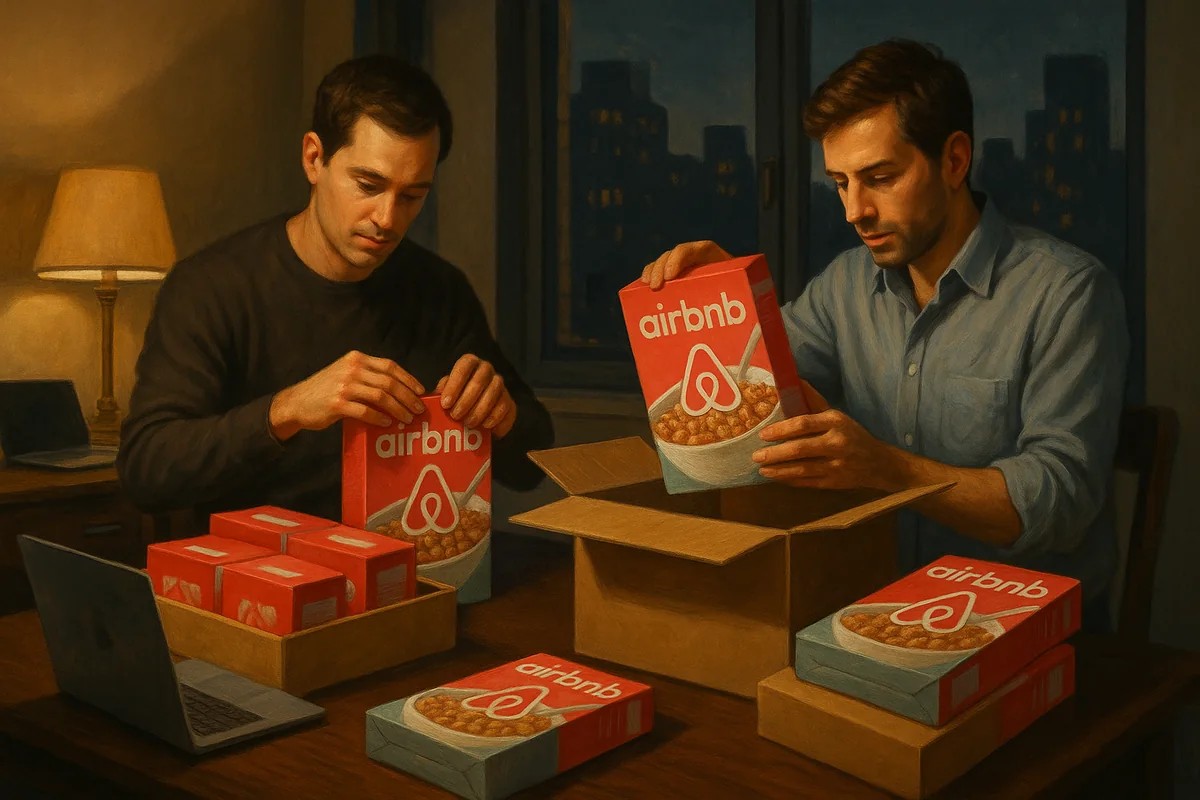
TL;DR: In 2008, Airbnb’s three co-founders sold limited-edition cereal boxes for $40 each to survive mounting credit-card debt and investor rejection. That unconventional hustle—generating roughly $30,000 and catching the eye of a major seed investor—demonstrated the execution ability that later built a company now valued in the tens of billions of dollars.
By mid-2008, Brian Chesky, Joe Gebbia, and Nathan Blecharczyk had launched a platform allowing hosts to rent out spare rooms, but traction was painfully slow. The founders were personally deep in debt, watching their credit-card balances climb while investors turned them down. Many venture capitalists dismissed the idea of strangers sharing homes as too risky or niche. The team needed cash not for office space or marketing blitzes, but simply to keep the lights on and the servers running.
The Cereal-Box Gamble
With the 2008 U.S. presidential election approaching, Chesky and Gebbia spotted an opportunity at the intersection of politics and novelty. They designed two limited-edition cereal boxes: Obama O’s (“The Breakfast of Change”) and Cap’n McCain’s (“A Maverick in Every Box”). The boxes themselves were hand-assembled, filled with generic cereal purchased in bulk, and marketed as collectibles rather than breakfast food. At $40 per box, the price was steep—but the founders bet that political enthusiasts and memorabilia collectors would pay a premium for a one-of-a-kind item tied to a historic election.
The gamble paid off. According to accounts shared by Chesky at Stanford Graduate School of Business, the team sold enough boxes to generate approximately $30,000. That infusion covered rent, server costs, and daily expenses for several crucial months. Just as importantly, the stunt revealed something about the founders: they were willing to do whatever it took—even if it looked ridiculous—to keep their vision alive.
How Cereal Caught an Investor’s Attention
Paul Graham, co-founder of the prestigious startup accelerator Y Combinator, had initially passed on Airbnb. But when Chesky showed him a box of Obama O’s, Graham’s perspective shifted. He reportedly said that if the founders were creative and scrappy enough to fund their company by selling cereal, they were the kind of people Y Combinator wanted to back. In early 2009, Airbnb was accepted into Y Combinator’s winter batch, receiving seed funding and mentorship that helped the platform refine its product, improve its user experience, and eventually attract larger venture rounds.
Nathan Blecharczyk later reflected that the cereal episode was less about the money and more about proving resourcefulness under constraints. Investors see hundreds of polished pitch decks, but few teams demonstrate the same level of hustle when the bank account hits zero. The cereal boxes became a tangible symbol: these founders would not quit when Plan A failed.
From Survival Mode to Global Platform
After joining Y Combinator, Airbnb iterated rapidly. The team refined the booking flow, invested in professional photography for listings, and expanded beyond air-mattress rentals to entire apartments and homes. By 2011, Airbnb had facilitated bookings in more than 10,000 cities, and major venture firms began writing checks. The company went public in December 2020, and as of 2026 its market capitalization fluctuates in the range of tens of billions of dollars, making it one of the most recognized brands in global travel.
The cereal boxes, meanwhile, have become startup folklore. Chesky has shared the story at conferences and in interviews, using it to illustrate a broader principle: when traditional funding doors slam shut, unconventional solutions can open unexpected ones. The founders did not wait for permission or a perfect business plan; they acted on what they could control.
What Founders and Teams Can Learn
The Airbnb cereal story offers several transferable lessons for anyone navigating financial constraints or investor skepticism:
- Resourcefulness beats perfection. A hand-assembled cereal box was far from a polished product, yet it solved the immediate cash-flow problem and demonstrated creativity.
- Execution signals commitment. Investors often look for proof that a team will persist through setbacks. Tangible action—even quirky action—can be more persuasive than another revised pitch deck.
- Constraints drive innovation. Limited budgets force teams to test unconventional ideas that well-funded competitors might never consider.
- Timing and cultural relevance matter. The founders capitalized on a specific moment—the 2008 election—when demand for political memorabilia was high.
- Small wins build momentum. The $30,000 from cereal sales did not transform Airbnb overnight, but it bought time and credibility when both were scarce.
For professionals in any field, the principle is the same: when you lack resources, showcase what you can do rather than explaining what you cannot. Execution under constraints often speaks louder than a flawless plan on paper.
Frequently Asked Questions
Did the founders really make $30,000 from cereal boxes? Yes. Multiple accounts, including statements by CEO Brian Chesky, confirm that the limited-edition Obama O’s and Cap’n McCain’s boxes sold for about $40 each and generated roughly $30,000 in total revenue during the 2008 election season. That money was used to cover operating expenses while the founders sought venture backing.
Was the cereal idea planned from the start, or was it a last resort? Chesky has described the cereal stunt as somewhat accidental—a creative response to desperation rather than a calculated marketing strategy. The team needed cash immediately, saw an opportunity in the election cycle, and executed quickly. The fact that it later impressed Paul Graham was an unplanned bonus that ultimately opened the door to Y Combinator and formal seed investment.
Source note: This article synthesizes public reporting from Fortune, CNBC, the University of Chicago Polsky Center, and Founded.com, all of which document the Airbnb founders’ 2008 cereal venture and its role in the company’s early survival. No private dialogue or internal documents were used.