
TL;DR: Luckin Coffee faked about $300 million of 2019 sales with ghost buyers and vouchers.
Store videos exposed it; the chain crashed, then outsold Starbucks in China.
Most accounting frauds start in a spreadsheet. Luckin Coffee’s started at the cash register, or rather in a simulation of one. Between April 2019 and January 2020, the self-styled “Starbucks of China” manufactured more than RMB 2.1 billion, over $300 million, in retail sales that never happened, according to the SEC’s December 2020 enforcement announcement. Understanding how a coffee chain fakes coffee, and how a team of investigators with camcorders caught what an audit did not, makes this one of the most instructive fraud cases of the past decade.
Ghost Buyers, Bulk Vouchers, and an Items-per-Day Dial
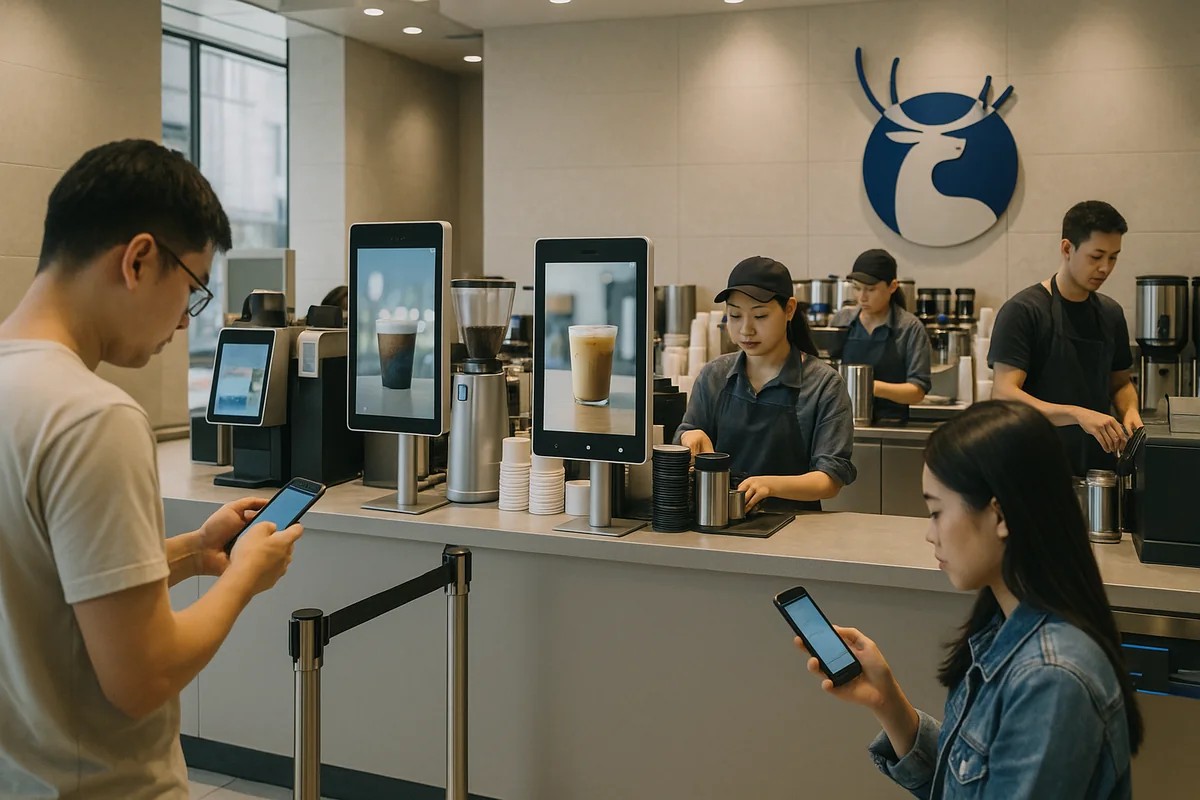
Luckin’s app-only model created the opening. Every cup was ordered through a smartphone, paid digitally, and typically discounted with coupons, so revenue existed first as database entries, not cash in a till. The SEC’s complaint describes three overlapping purchasing schemes built on that plumbing. Fabricated “individual customers,” registered in bulk, bought and redeemed coupon vouchers for drinks no one collected. Shell companies posing as corporate buyers placed large voucher orders. And related parties, entities linked to company insiders, supplied the money that flowed through these fake purchases so the receipts looked funded. Because a voucher “redeemed” in a database is indistinguishable from a latte handed across a counter, the scheme generated revenue that reconciled perfectly with payment records, since both sides of the transaction were written by the same people.
The output of the machine was a single, sensitive metric: items sold per store per day. Investors valued Luckin on store-level throughput, so that was the dial the scheme turned. By the later analysis of short-sellers, reported items per store were inflated by at least 69% in the third quarter of 2019 and 88% in the fourth, and the net price per item overstated by about 12%. The company was not exaggerating a real business at the margins; it was roughly doubling it, quarter after quarter, in the metric every analyst model keyed on.
Fake Beans and Inflated Ads: Closing the Cash Loop
Fake revenue creates a bookkeeping problem: money that comes in from nowhere must appear to go somewhere. Luckin’s answer was fake costs. The SEC found the company inflated expenses by more than $190 million, including fabricated procurement, purchases of raw materials and services from related parties that existed mainly to recycle cash back out of the company and make the phony sales look economically real. The anonymous short report separately alleged that third-quarter 2019 advertising spending was overstated by roughly 150%, with the excess plausibly rerouted to fund revenue. Employees maintained a fake operations database and altered accounting and bank records so that internal figures, the numbers an auditor would sample, matched the invented ones. Revenue was overstated by roughly 28% in the period ended June 30, 2019, and about 45% in the period ended September 30, per the SEC’s findings.
The Controls That Missed RMB 2.1 Billion
Every external check failed in sequence. The auditor’s confirmations ran into records that had been doctored end to end; because orders, payments, inventory, and bank statements were falsified together, cross-checking one against another produced false comfort. The board’s audit committee had no independent data feed and learned of the scheme only when the fabrications surfaced during audit work on the 2019 annual report, which was never filed. The company ultimately lost its listing for that missing filing. Most striking, in January 2020, days before the fraud became public, Luckin completed a follow-on share sale and convertible note offering underwritten by major Wall Street banks. Across the fraud period the company raised more than $864 million from equity and debt investors, the SEC noted, capital priced off numbers its own COO was inventing.
11,000 Hours of Video Against an Audited Ledger
The fraud was undone by people who ignored the ledger entirely and counted cups. On January 31, 2020, Muddy Waters Research said it had gone short based on an anonymous 89-page report it found credible. The report’s method was brute-force physical observation: investigators, reportedly around 1,500 full- and part-time staff, recorded more than 11,000 hours of video across hundreds of Luckin stores, logging foot traffic and order numbers for full business days, and collected over 25,000 customer receipts. It also noted what the videos implied about idle stores: quiet counters at hours when the reported averages required a steady stream of orders. Order numbers on receipts let analysts reconstruct true daily volumes; the gap between observed throughput and reported throughput was the fraud, measured from the sidewalk. Luckin “categorically denied” the report on February 3, calling its methodology flawed. The denial bought the company nine weeks.
From Denial to Delisting in Five Months
On April 2, 2020, Luckin’s own special committee ended the argument. The company disclosed that COO Jian Liu and employees reporting to him had fabricated transactions totaling roughly RMB 2.2 billion during 2019. The stock, which had fallen more than 80% in premarket trading, closed down about 75% on the day, as CNBC reported, vaporizing billions of dollars in market value. The dominoes then fell fast:
- May 12, 2020: the board fired Liu and CEO Jenny Zhiya Qian as the internal investigation advanced.
- June 29, 2020: Nasdaq suspended trading after Luckin withdrew its appeal of the delisting decision, per Nasdaq’s own report.
- July 2020: chairman and co-founder Charles Lu Zhengyao, whose allies had funded parts of the scheme through related entities, was forced off the board after a prolonged fight.
- December 16, 2020: Luckin agreed to a $180 million SEC penalty, neither admitting nor denying the findings, the largest US enforcement action against a China-based issuer in years, as the South China Morning Post reported.
The Strange Epilogue: The Fake Growth Story Came True
Then the case took a turn almost no securities fraud takes. Luckin filed for Chapter 15 protection in New York in February 2021 to restructure its offshore debt while its thousands of stores kept pouring coffee. Private equity firm Centurium Capital led a roughly $240 million rescue investment, bought out the disgraced founders’ stakes, and became controlling shareholder, installing new management and controls, a turnaround chronicled by Fortune. The reconstituted company emerged from bankruptcy in 2022, by which point its store count in China had already passed Starbucks’, and in 2023 reported about RMB 24.9 billion, roughly $3.5 billion, in revenue, surpassing Starbucks’ China business in annual sales for the first time, according to Fortune’s later reporting. The growth story management had faked in 2019 was, it turned out, achievable honestly, just a few years behind schedule.
The One Ledger a Coffee Chain Cannot Fake
The mechanics carry a lesson sharper than the usual homily about governance. Luckin’s engineers could fabricate customers, coupons, procurement contracts, expense lines, an entire parallel operations database, everything that lives in software. What they could not fabricate was physical throughput: actual people carrying actual cups out of observable storefronts. A retail business’s stores are a public API to its income statement, and anyone patient enough to stand outside with a camera can query it. The audited numbers lost to the receipts because audits sample the company’s records, while the videographers sampled reality. And the coda is the strangest part: the unit economics being simulated were close enough to true that the same stores, honestly counted, eventually beat Starbucks. Luckin’s frauds were crimes of impatience, faking a future that was arguably coming anyway, which is precisely why the fabrication was so hard to spot from inside the numbers and so easy to spot from across the street.
Source note: This account draws on the SEC’s December 2020 press release and complaint, contemporaneous reporting by CNBC, Nasdaq, and the South China Morning Post, and retrospective coverage by Fortune.